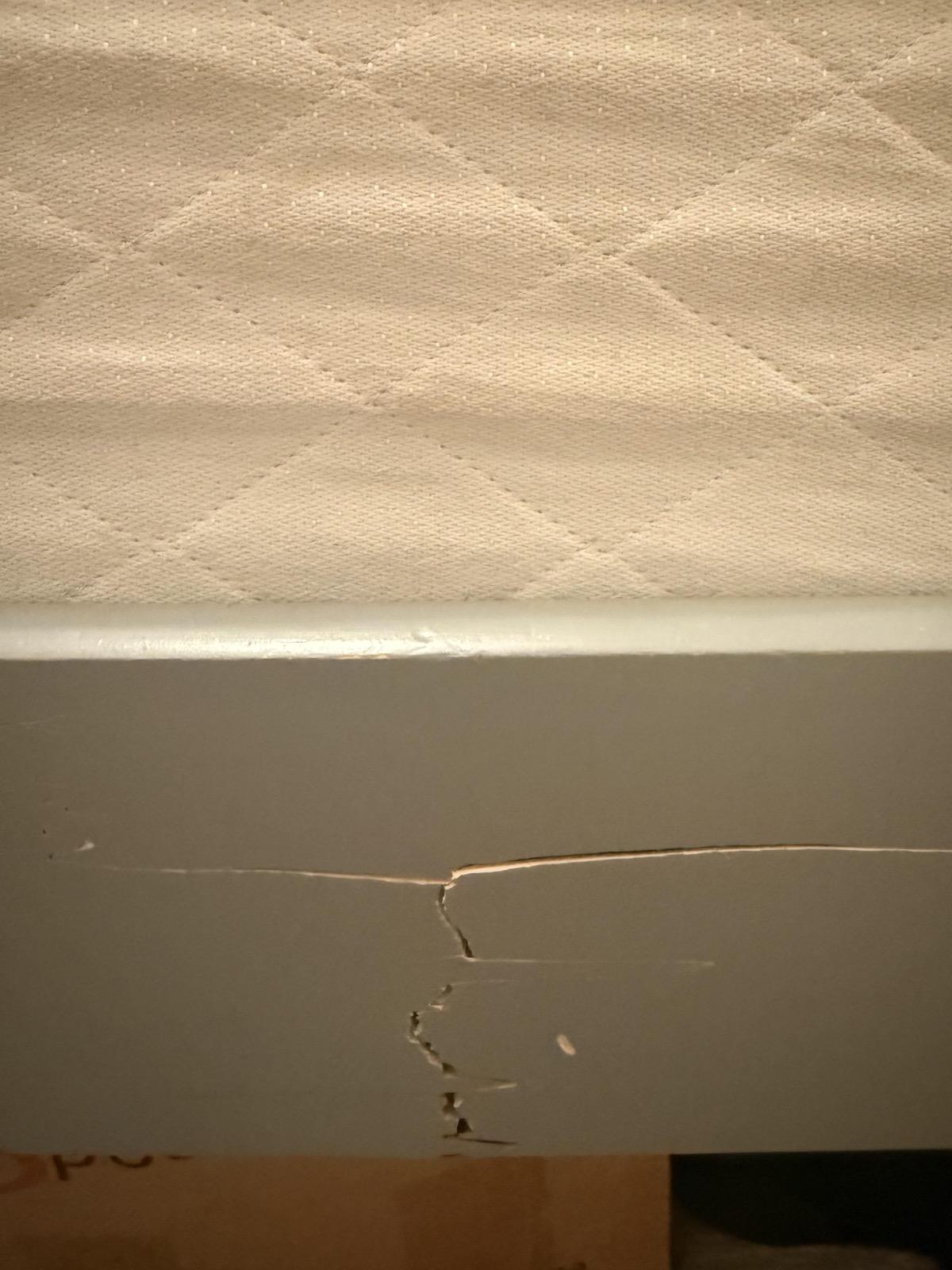
I've dismantled thousands of bed frames at my recycling facility. Cracked open particleboard panels that still reek of formaldehyde after four years. Broken down metal frames coated in mystery paint that chips into dust. Pulled apart upholstered headboards stuffed with foam that was loaded with flame retardant chemicals before regulations caught up. (For the broader picture of bedroom air quality, see my complete guide to toxins in your bedroom.)
Here's what I can tell you from that experience: most bed frames contain some level of chemical off-gassing, but the risks vary enormously by material. A solid maple frame with tung oil finish and a $99 particleboard platform bed from Amazon are not in the same universe when it comes to what you're breathing while you sleep.
That matters because you spend roughly a third of your life in bed — usually in a bedroom with the door closed and limited ventilation. Everything your bed frame off-gasses goes straight into the air you breathe for 7-8 hours every night.
For kids, the risk multiplies:
- They breathe 2-3 times more air per pound of body weight than adults
- They sleep 10-14 hours daily (vs. 7-8 for adults)
- Their developing organs are more vulnerable to chemical exposure
This guide breaks down every material you'll find in a bed frame:
- Wood types — solid vs. engineered, and why it matters
- Finishes — from safe natural oils to concerning lacquers
- Adhesives — the hidden formaldehyde sources
- Metals — the cleanest option for chemical sensitivity
- Upholstery — foam, fabric, and flame retardants
I'll give you actual emission data, regulatory limits, and what I've learned from seeing these materials at the end of their lifecycle. If you want to skip straight to recommendations, check out my guide: Eco-Friendly & Non-Toxic Bed Frames for a Healthy Bedroom.
Solid Wood: Not All Species Are Created Equal
People assume solid wood means safe. It's mostly true — solid wood is the cleanest material category for bed frames by a wide margin. But wood itself emits volatile organic compounds, primarily terpenes and aldehydes. Whether these natural emissions matter depends on the species and your individual sensitivity.

The big divide is hardwoods versus softwoods, and the difference shows up in both durability and chemical emissions.
Softwoods: cheaper, but higher emissions
Pine, spruce, and cedar are the most common softwoods in bed frames, especially budget and rustic designs. The tradeoffs:
- Cheap and widely available — you'll find these in most "rustic" or budget frames
- Highest natural VOC emissions — pine sapwood releases α-pinene at 3,459 µg/m³
- Cedar is even more intense — those distinctive terpenes trigger symptoms in chemically sensitive people
- Not carcinogens — but they cause eye/respiratory irritation and aggravate allergies and asthma
Heat treatment at 120°C removes terpenes almost completely — but I've never seen a bed frame manufacturer advertise heat-treated softwood. It's an industrial process used for construction lumber, not furniture.
Why durability matters: Janka hardness ratings
The Janka test measures how much force it takes to embed a steel ball into wood — higher numbers mean harder wood that resists denting and wear at joints. Anything above 900 lbf handles furniture use well.
| Wood Species | Janka (lbf) | Type | VOC Concern |
|---|---|---|---|
| Cedar | 320-350 | Softwood | High terpenes |
| Pine (Eastern White) | 380 | Softwood | High terpenes |
| Pine (Southern Yellow) | 690 | Softwood | High terpenes |
| Spruce | 400-510 | Softwood | Moderate terpenes |
| Poplar | 540 | Hardwood | Low |
| Birch | 1,260 | Hardwood | Low |
| Beech | 1,300 | Hardwood | Elevated formaldehyde |
| Walnut | 1,010 | Hardwood | Low |
| Cherry | 950 | Hardwood | Low |
| Oak (Red) | 1,290 | Hardwood | Low |
| Oak (White) | 1,360 | Hardwood | Low |
| Hard Maple | 1,450 | Hardwood | Low |
| Rubberwood | 960-1,000 | Hardwood | Low |
| Acacia | 1,700-2,300 | Hardwood | Low |
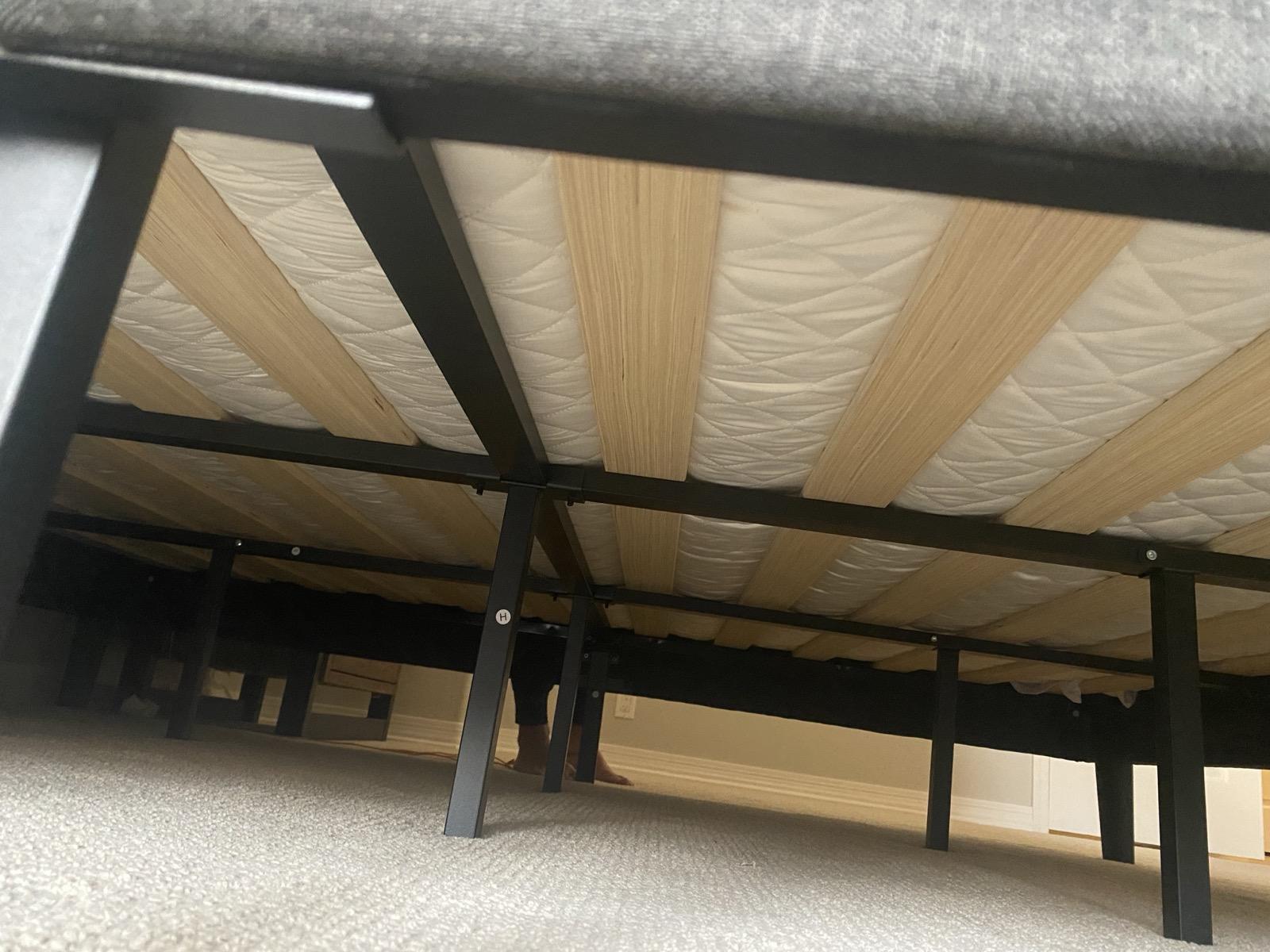
Cedar at 320-350 lbf? I see the evidence at my facility — dents accumulate at joint locations, bolt holes elongate, and the frame gets wobbly years before a hardwood frame would show wear. (For more on how construction quality affects longevity, see why bed frames fail.)
Hardwoods: lower emissions, better durability
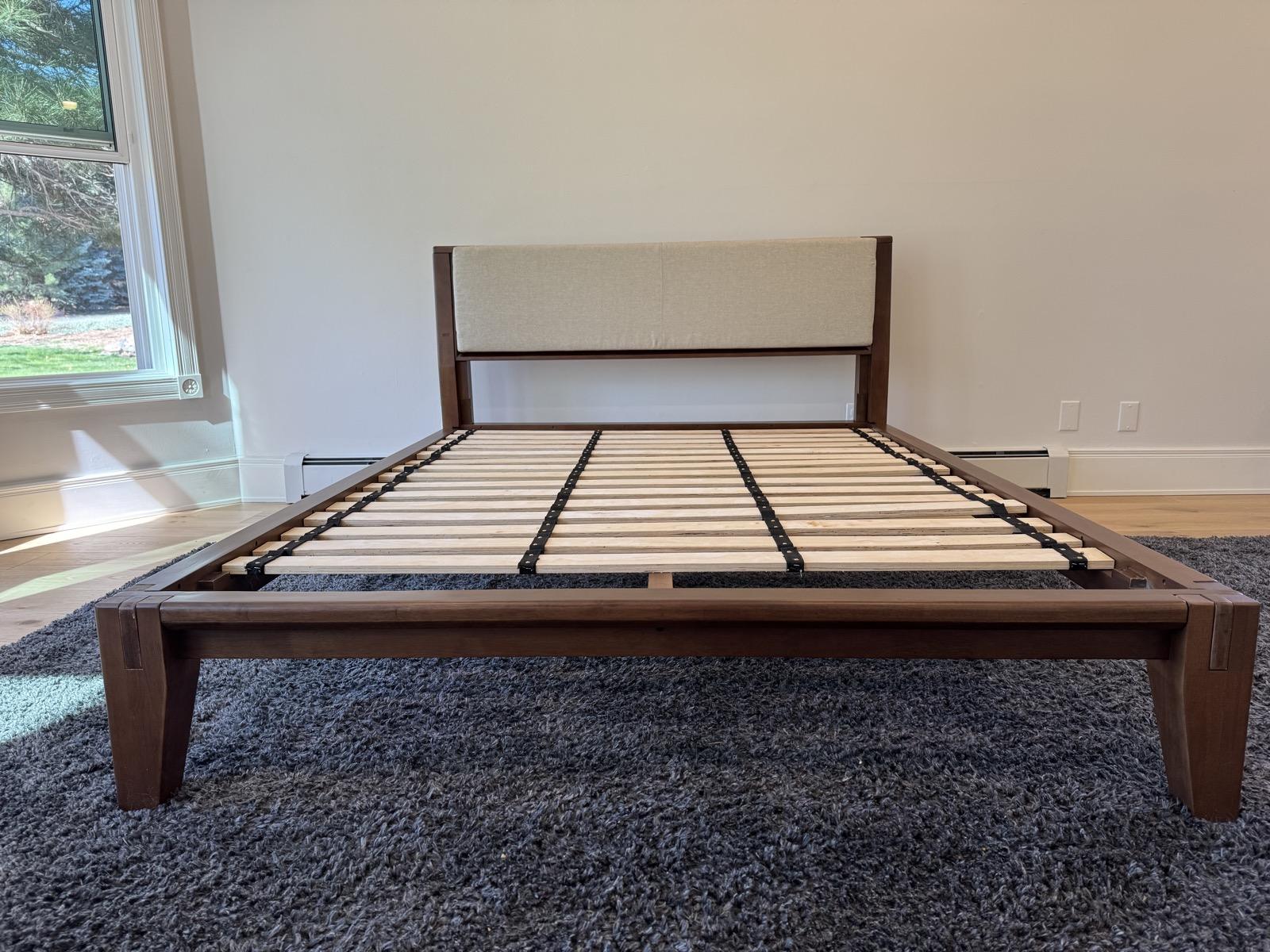
The safest options for chemically sensitive people:
- Maple, birch, and poplar — lowest odor, minimal terpene content, closed-grain structures that don't trap volatile compounds
- Hard maple (1,450 lbf) — ideal for joints and stress points where you need structural integrity
- Oak (red and white) — the workhorse of furniture building, strong, takes finishes beautifully, low VOC emissions
- Walnut and cherry — premium choices with beautiful grain and moderate hardness
- Rubberwood (960-1,000 lbf) — sustainably harvested solid hardwood, but watch the finish and adhesives
One surprise: Beech emits formaldehyde at rates 6 times higher than pine, oak, or poplar — 84 versus 14-16 µg/m²/h. All wood contains trace natural formaldehyde at around 0.01 ppm, but beech's elevated emissions make it a questionable choice for anyone pursuing the lowest possible exposure.
The bottom line on solid wood emissions
Key takeaway: All solid wood emissions decline significantly within two weeks and continue decreasing over 1-2 years. Aged or reclaimed solid wood furniture is the lowest-emission option in this entire guide.
If you're buying a new solid wood frame:
- Give it a week in a ventilated room before putting it in the bedroom
- Prioritize hardwoods over softwoods if you have sensitivities
- Ask about the finish — that's often the bigger concern than the wood itself
Engineered Wood: The Formaldehyde Problem
This is where things get ugly. MDF, particleboard, and certain plywood products aren't just wood — they're wood fibers or chips bound together with urea-formaldehyde (UF) adhesive. That adhesive makes up 6-12% of particleboard and up to 10% of MDF by weight.
The chemistry you need to understand: The resin releases formaldehyde continuously through reversible hydrolysis — a chemical reaction that technically never completely stops. Heat and humidity make it worse.
What are MDF, particleboard, and plywood?
MDF (medium-density fiberboard):
- Wood fibers broken down to fine pulp, mixed with UF resin, pressed into dense panels
- Smooth, easy to paint, cheap
- Highest formaldehyde emitter — 0.11 ppm allowable under federal limits
Particleboard:
- Larger wood chips and shavings bound with UF resin
- Cheapest engineered wood — most common in budget furniture
- Allowable emissions: 0.09 ppm
- I identify these by weight alone — lighter than MDF, far lighter than solid wood
Plywood:
- Layers of thin wood veneer glued with alternating grain directions
- Stronger than MDF or particleboard
- Can be made with formaldehyde-free adhesives (NAF versions)
- Emission limit: 0.05 ppm — best of the engineered options
Current emission limits
The CARB Phase 2 / TSCA Title VI standards became federally enforceable in 2018. Every composite wood product sold in the US must meet these limits:
| Product | Emission Limit |
|---|---|
| Hardwood plywood (veneer or composite core) | 0.05 ppm |
| Particleboard | 0.09 ppm |
| MDF (>8mm thickness) | 0.11 ppm |
| Thin MDF (≤8mm) | 0.13 ppm |
These limits cut emissions 50% compared to Phase 1 standards. Progress? Yes. But here's the context that matters: the WHO indoor air quality guideline for formaldehyde is 0.08 ppm (80 ppb). A bedroom with a new compliant MDF bed frame, an MDF nightstand, and MDF dresser can easily approach or exceed that health threshold.
How long formaldehyde actually off-gasses
This is the part manufacturers don't want to talk about. I asked this question to every rep I could find, and nobody gives a straight answer. The research does:
| Timeline | What's Happening |
|---|---|
| First few weeks | Peak emissions — that "new furniture smell" is largely formaldehyde |
| 1-1.5 years | Half-life point — emissions roughly 50% of initial levels |
| 2 years | ATSDR says "most" formaldehyde has released |
| 7+ years | When chemically sensitive people consider it adequately off-gassed |
Humidity warning: The UF bond is never totally stable. Moving from 30% to 100% relative humidity at 25°C increases formaldehyde release 5.9-8.3 fold. That's why emissions spike during humid summers and in bedrooms without good climate control.
Practical tip: If you buy a cheap particleboard bed frame, crack a window in the bedroom for the first few months. Seriously. The difference in air quality is measurable.
Formaldehyde-free engineered wood exists
The good news is manufacturers have developed alternatives to UF adhesives:
- PureBond plywood (Columbia Forest Products) — soy-based adhesive, tests below detection limits (<0.05 ppm), now 60% of North American decorative hardwood plywood
- MDI-bonded panels (Roseburg Medex, Uniboard NU Green) — zero formaldehyde once cured
What to look for on labels:
- NAF (No Added Formaldehyde) — no formaldehyde-based resin used at all
- ULEF (Ultra-Low Emitting Formaldehyde) — emissions below 0.04-0.05 ppm, close to background levels
The veneer and laminate deception
Here's something that catches a lot of shoppers: "wood veneer" and "wood laminate" sound like wood. They're not.
- Wood veneer = thin layer of real wood glued onto particleboard/MDF
- Wood laminate = printed paper/plastic made to look like wood, glued onto particleboard/MDF
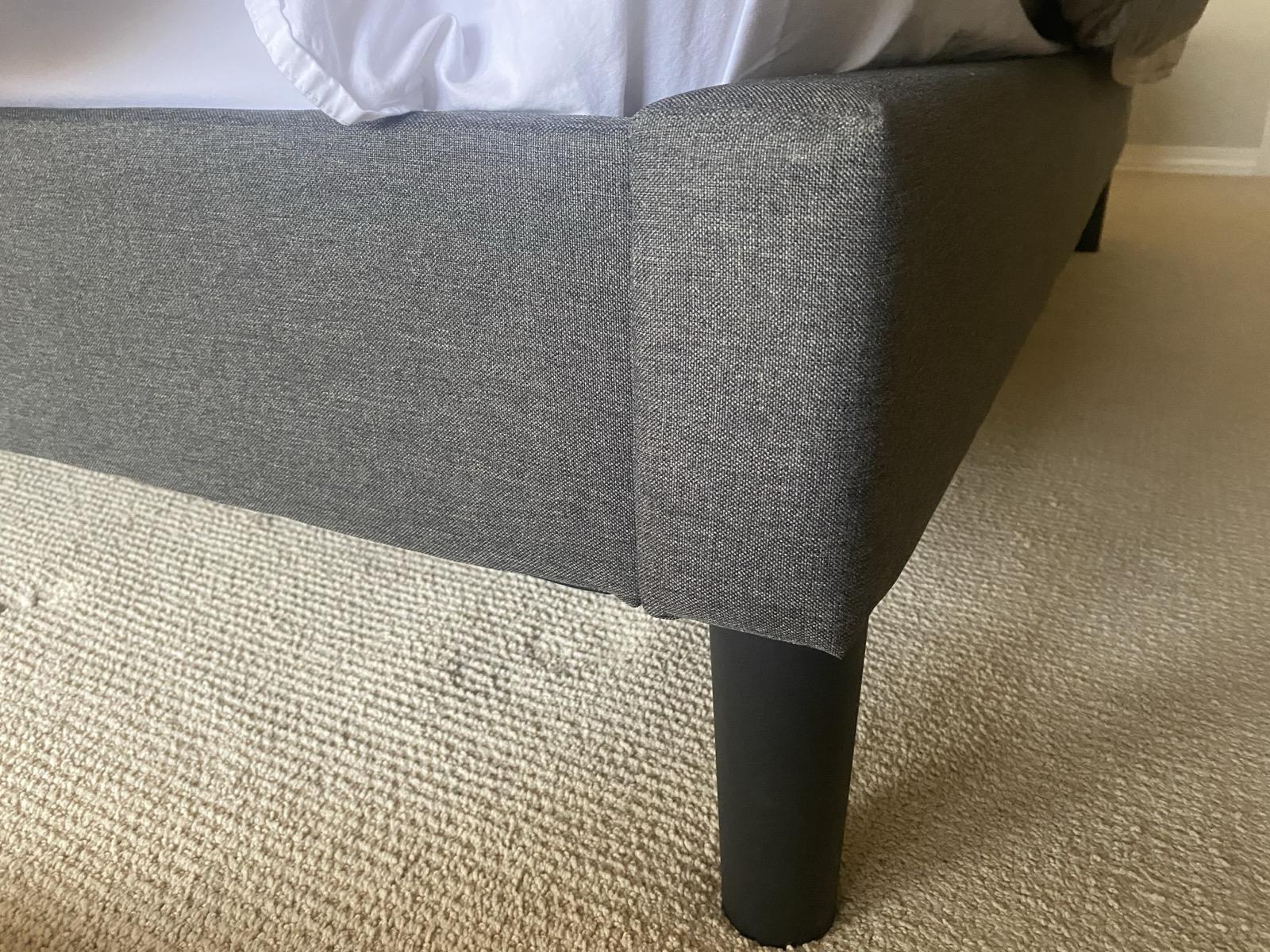
The surface looks and feels like wood. The structural material underneath is engineered wood with all the formaldehyde concerns I just described.
Red flags when shopping:
- "Wood" without "solid wood" = assume engineered
- "Wood veneer" = assume particleboard or MDF underneath
- Core material not mentioned = assume the worst
Wood Finishes: The Hidden Variable
A solid wood bed frame can still emit significant VOCs depending on what's sprayed, brushed, or wiped onto it. The finish is often the bigger concern than the wood itself — and it's the part most shoppers never think about.

Natural oils: the gold standard
Pure Tung Oil
- Zero VOCs in its unadulterated form
- FDA approved for food contact once cured (30 days)
- Penetrates wood rather than sitting on top — no film to chip or peel
- Watch out: "tung oil finish" often contains petroleum solvents — read ingredients
Raw Linseed Oil
- Just crushed flaxseed — similarly safe to tung oil
- Requires weeks to months for full cure
- Avoid "boiled linseed oil" unless it says "polymerized" — contains toxic metallic driers
Hemp oil is the mildest option for chemically sensitive people. Less durable than tung oil but virtually no odor even during application.
Shellac: surprisingly safe
Shellac gets overlooked. It's a natural resin secreted by lac beetles, dissolved in ethanol. The VOC content looks scary on paper — about 730 g/L — but those VOCs are just alcohol that evaporates completely during the fast 15-30 minute dry time. Once cured, shellac is FDA-approved for food contact.
Shellac also makes an excellent formaldehyde-blocking sealer. If you have particleboard furniture and want to reduce emissions, sealing exposed edges and surfaces with shellac is one of the most effective DIY interventions available.
Water-based polyurethane: the middle ground
Water-based polyurethanes emit 100-275 g/L VOCs — dramatically lower than oil-based versions. The concern here is glycol ethers, particularly 2-butoxyethanol. Animal studies link glycol ethers to reproductive effects (fewer offspring, underdeveloped bones in rats). Human data is limited, but building science professionals take this seriously enough to recommend ventilation during application and curing.
Full cure takes 7-14 days, with fumes largely gone in 2-3 weeks. Once fully cured, water-based poly is considered safe for consumer contact. If a bed frame manufacturer uses water-based polyurethane and you give it a couple weeks to cure in a ventilated space, the risk is minimal.
Oil-based polyurethane: high concern
Oil-Based Polyurethane
- Contains toluene, xylene, and mineral spirits at 450-550 g/L VOCs
- Toluene is a CNS depressant — causes headaches, dizziness, fatigue
- Full cure: 20-30 days | Complete off-gassing: 1-6 months
- Still used because it produces superior depth and amber coloring
Nitrocellulose lacquer: the factory favorite
Nitrocellulose Lacquer
- Contains 1-5% toluene and 1-5% xylene
- Dries in minutes — factories love it because speed means profit
- Off-gassing continues 4-6 weeks after application
- This is what's on most imported furniture
That chemical smell when you unbox new furniture? Nitrocellulose lacquer is the primary source. At occupational exposure levels, chronic symptoms include memory loss, lethargy, tremors, and personality changes.
UV-cured finishes: the future
UV-cured finishes are the ideal factory option. Zero VOC, instant cure under UV light, and absolutely no off-gassing after application. You see this technology on pre-finished hardwood flooring, and it's expanding into furniture manufacturing. If a bed frame manufacturer advertises UV-cured finish, that's genuinely excellent. No curing time, no emissions, no compromise.
Finish comparison at a glance
| Finish Type | VOC (g/L) | Off-Gassing | Safe After Cure? |
|---|---|---|---|
| Pure tung oil | 0 | 30 days cure | Yes — FDA approved |
| Raw linseed oil | 0 | Weeks to months | Yes |
| Shellac | ~730 (ethanol) | 15-30 minutes | Yes — FDA approved |
| Water-based poly | 100-275 | 2-3 weeks | Generally yes |
| Oil-based poly | 450-550 | 1-6 months | Yes once cured |
| Nitrocellulose lacquer | High | 4-6 weeks | Acceptable once cured |
| UV-cured | 0 | Instant | Yes — zero emissions |
Adhesives and Glues: What's Holding Your Frame Together
Even solid wood bed frames use glue at joints. The formaldehyde question doesn't stop at panels — it extends to assembly adhesives. (For more on how frames are put together, see how bed frames are built.)
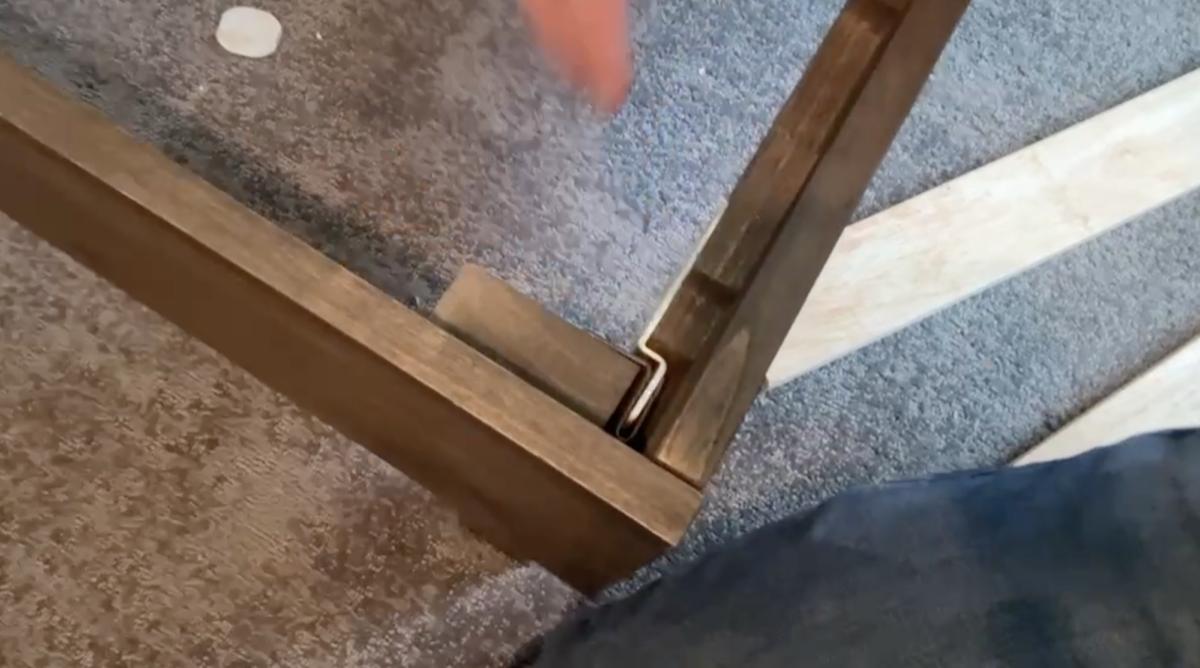
PVA wood glue: mostly safe
Titebond Original (the yellow bottle) tests at zero formaldehyde emissions in chamber testing. This is the standard woodworking glue, and it's genuinely clean once cured.
| Product | Formaldehyde | Notes |
|---|---|---|
| Titebond Original | 0 ppb | Genuinely clean once cured |
| Titebond II | 13 ppb | Below WHO 80 ppb guideline |
| Titebond III | 21 ppb | Below WHO 80 ppb guideline |
Context that matters: The amount of PVA glue in a bed frame's joints is tiny compared to the UF resin in a particleboard panel. If your frame is solid wood assembled with Titebond, the glue is not your concern. If your frame is particleboard, the panel adhesive — not the joint glue — is the formaldehyde source.
Urea-formaldehyde in panel adhesives
This is the one that matters. UF resin is used to bind MDF, particleboard, and conventional plywood because it's cheap, cures fast, and produces strong bonds.
The problem: UF bonds are reversible. Heat and humidity break down the bond, releasing formaldehyde gas. This process continues for the life of the product.
Other formaldehyde-based adhesives:
- Phenol-formaldehyde (PF) — used in exterior plywood and OSB, emits far less than UF (more stable bond)
- Melamine-urea-formaldehyde (MUF) — reduces emissions vs. straight UF but doesn't eliminate them
Hot melt adhesives
EVA, polyolefin, and PUR hot melts are used for edge banding — those thin strips covering the raw edges of particleboard and MDF panels. These adhesives don't contain formaldehyde and present minimal consumer exposure once cooled.
Why peeling edge banding matters: Edge banding exists partly to contain formaldehyde emissions from the panel underneath. When it peels off (which it does — I see it constantly), it's removing a barrier that was helping contain formaldehyde. Sealed edges emit less than exposed edges.
Metal Bed Frames: The Cleanest Option for Chemical Sensitivity
If you have serious chemical sensitivity issues, powder-coated steel is probably your best bet. The chemistry is straightforward: steel itself is chemically inert, and powder coating produces near-zero VOC emissions with no ongoing off-gassing.
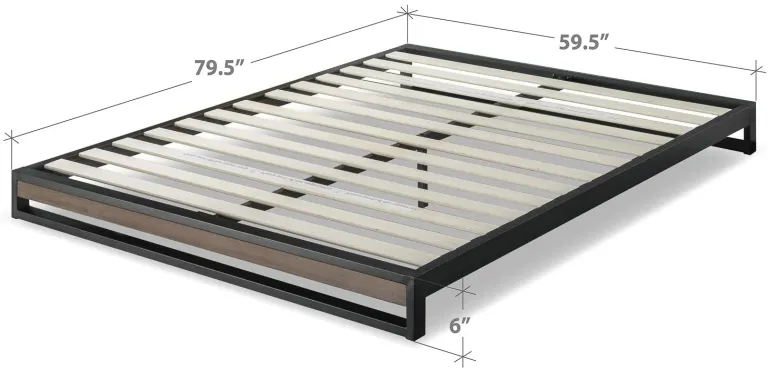
How powder coating works
Why powder coating is the cleanest option:
- Dry powder particles get electrostatic charge, stick to grounded metal
- Cures at 350-400°F for 10-30 minutes
- No solvents whatsoever — coating is effectively 100% solids
- Nothing evaporates during or after application
- EPA classifies as "compliant (low/no-VOC/HAP) coatings"
Painted metal versus powder-coated
Not all metal bed frames are powder-coated. Budget frames may use conventional spray paint. Here's the difference:
| Attribute | Powder Coating | Spray/Liquid Paint |
|---|---|---|
| VOCs | Zero | 50-400+ g/L |
| Off-gassing | None | Weeks after application |
| Durability | Excellent — resists chipping, scratching, fading | Thinner, more susceptible to chipping |
| Application | Uniform thick application | Variable thickness |
Shopping tip: When shopping for metal frames, "powder-coated" is the specification you want. If the listing just says "painted" or "coated" without specifying powder coat, assume liquid paint.
Chrome plating and nickel allergy
Chrome-plated bed frames introduce one meaningful health concern: nickel allergy. Decorative chrome uses a nickel underlayer beneath the chromium surface. Nickel allergy affects 10-20% of the population (significantly more common in women). If the chrome layer wears through at contact points, the exposed nickel triggers contact dermatitis — red, itchy, irritated skin wherever you touch it.
The hexavalent chromium used in plating baths is a serious carcinogen, but it doesn't exist in the finished product. The chrome surface on your bed frame is metallic chromium (Cr0), which is chemically stable and safe. The concern is only the nickel underneath if the chrome wears through — and on a bed frame, direct skin contact is usually minimal.
Antique metal frames and lead paint
Pre-1977 painted metal frames may contain lead-based paint. This is the one genuinely serious safety concern with vintage iron and brass beds. The US banned lead paint in consumer products in 1978, so anything painted before then needs testing.
Home lead testing kits cost $10-30 and are available at any hardware store. If the paint tests positive for lead:
If the paint is intact and not flaking, encapsulation with a lead-safe sealant is adequate. The lead stays locked under the sealant.
If the paint is deteriorated, chipping, or flaking, you need professional stripping. Don't sand lead paint yourself — the dust is the primary exposure pathway and it's incredibly difficult to contain without proper equipment.
Upholstered Bed Frames: Foam, Fabric, and Flame Retardants
Upholstered frames are the most complex category because they layer multiple materials, each with its own concerns:
- Polyurethane foam — VOCs from manufacturing
- Fabric treatments — stain resistance chemicals (often PFAS)
- Flame retardants — a genuinely troubling regulatory history
Polyurethane foam padding
The foam in upholstered headboards and side rails emits VOCs from manufacturing catalysts and siloxanes:
- Peak emissions: First 3-7 days
- Background levels: Approximately 32 days
- That "new foam smell" is real chemistry, not just "new product" odor
The bigger concern — historically — was what manufacturers added to the foam to meet fire safety standards. (Similar issues affect mattresses — see my guide on fiberglass fire barriers in mattresses for the full picture.)
The flame retardant legacy
California's original TB117 standard (1975) required furniture foam to withstand a 12-second open flame test. Foam can't do that on its own, so manufacturers doused it with chemical flame retardants.
The three chemicals you should know:
PentaBDE
- Linked to thyroid disruption, neurodevelopmental delays, reproductive toxicity
- Banned in California (2003), phased out in EU
- Still present in pre-2004 foam furniture
TDCPP (Chlorinated Tris)
- California Prop 65 carcinogen
- EPA: "likely to be carcinogenic to humans"
- Found in 96% of US house dust — migrates out of foam over time
TCEP
- EU "Substance of Very High Concern"
- EPA determined "unreasonable risk" in 2024
- Also migrates from foam into household dust
TB117-2013 changed everything
In 2013, California rewrote the standard (effective 2015, adopted federally in 2021). TB117-2013 uses a smolder test instead of open flame, which manufacturers can pass without chemical flame retardants using barrier fabrics and smart construction. Products must now label whether they contain added flame retardants.
This was a genuine regulatory victory. If you're buying an upholstered bed frame made after 2015 from a reputable manufacturer, it should be flame-retardant-free. Check the TB117-2013 compliance label — it's required to disclose whether flame retardant chemicals were added.
CertiPUR-US certification for foam
CertiPUR-US screens foam for TDCPP, TCEP, and PBDEs (all prohibited), requires formaldehyde below 0.1 ppm, and limits total VOC emissions to <0.5 ppm. It's the most widely recognized foam certification in the US.
Limitations: CertiPUR-US certifies foam, not complete products. A bed frame could use CertiPUR-US foam but have a particleboard structure or use fabric treated with other chemicals. It's necessary but not sufficient for a "non-toxic" claim.
Natural alternatives: latex and wool
GOLS-certified organic latex requires minimum 95% certified organic raw material with strict limits on processing chemicals. Dunlop-process latex can achieve GOLS certification; Talalay typically cannot because the flash-freezing process requires synthetic additives. Natural latex eliminates flame retardant and VOC concerns entirely. It's expensive — expect to pay 2-3x more than polyurethane foam — but it's the cleanest padding option. (For a deeper comparison of foam types, see memory foam vs. latex.)
Wool batting is nature's flame retardant. Keratin (the protein in wool) has an ignition temperature of 570-600°C compared to cotton at 255°C. Wool's nitrogen content (14-16%) dilutes combustible gases, and it absorbs up to 30% of its weight in moisture. Its limiting oxygen index (25-26%) exceeds atmospheric oxygen (21%), meaning wool literally requires more oxygen than air provides to sustain combustion.
That's why organic mattress manufacturers use GOTS-certified wool as their sole flame barrier. No chemicals needed. If an upholstered bed frame uses wool batting, it doesn't need chemical flame retardants to meet any current fire standard.
Fabric treatments: PFAS and formaldehyde finishes
PFAS (per- and polyfluoroalkyl substances) — the "forever chemicals" — show up in polyester upholstery treated for water and stain resistance. A 2022 study found PFAS in 65% of tested children's clothing and 72% of products marketed as water/stain-resistant. California, New York, and Maine have enacted PFAS bans in textiles starting in 2025.
If a bed frame upholstery advertises "stain-resistant" or "water-repellent" fabric, ask what treatment was used. PFAS doesn't break down in the environment or your body — that's why they're called forever chemicals. For bedroom furniture, stain resistance isn't worth PFAS exposure.
OEKO-TEX Standard 100 certification tests textiles for formaldehyde, heavy metals, pesticides, PFAS, and other harmful substances. Class I (baby products) has the strictest limits at 16 mg/kg formaldehyde. Class IV (furnishing materials) allows more but still restricts the worst substances. If upholstery fabric carries OEKO-TEX certification, the fabric itself has been screened.
Microplastics: the emerging concern
Polyester upholstery sheds microfibers continuously. Indoor microplastic concentrations reach 1.7-16.2 particles/m³ in breathing zone measurements — 2-5 times higher indoors than outdoors. Polyester accounts for 81% of synthetic particles in inhaled indoor air.
Kids inhale up to 3 times more microplastics per body weight than adults and spend more time at floor level where fibers settle. Natural fiber alternatives — cotton, linen, wool, hemp — eliminate this exposure pathway entirely. For an upholstered bed frame, natural fabric over natural padding is the cleanest combination.
What Formaldehyde Actually Does to Your Health
I keep coming back to formaldehyde because it's the single most common chemical concern in bed frames. It shows up in:
- Engineered wood (MDF, particleboard)
- Certain finishes
- Some adhesives
- Even fabric treatments
IARC Classification: Group 1 Carcinogen — the highest classification, meaning there's sufficient evidence it causes cancer in humans. Specifically nasopharyngeal cancer, with growing evidence for myeloid leukemia.
Exposure thresholds
| Concentration | What Happens |
|---|---|
| 0.05-0.5 mg/m³ (40-400 ppb) | You can smell it |
| ~0.38 mg/m³ (310 ppb) | Eyes start to feel irritated |
| ~0.63 mg/m³ (510 ppb) | Measurable increased blinking |
| 0.1 mg/m³ (80 ppb) | WHO indoor air quality guideline |
| 0.75 ppm (750 ppb) | OSHA workplace 8-hour limit |
The WHO guideline of 80 ppb protects against sensory irritation in the general population. California's OEHHA chronic reference exposure level is far more conservative at 9 µg/m³ (7.3 ppb) — this stricter number is the basis for GREENGUARD Gold certification.
Typical homes without new furniture or recent renovations measure below 0.1 ppm. Homes with significant new particleboard or MDF furniture can exceed 0.3 ppm — three times the WHO guideline. (High humidity makes this worse — and also creates mold problems, so humidity control addresses multiple bedroom health issues.)
Why children are more vulnerable
Kids breathe 2-3 times more air per pound of body weight than adults. They sleep 10-14 hours daily. Their organ systems are still developing. And their hand-to-mouth behavior means they ingest more household dust — which is the primary exposure pathway for flame retardants.
A Japanese study found maternal formaldehyde exposure associated with neurodevelopmental delays in 12-month-olds. Indoor VOC studies consistently show children in higher-VOC homes are more likely to develop asthma, allergic rhinitis, and eczema.
For kids' bedrooms, the risk calculus shifts toward more conservative choices. Solid wood or certified low-emission engineered wood, GREENGUARD Gold certified products where available, and skip the synthetic upholstery. It's not paranoia. It's proportional response based on who's sleeping there and how long they're exposed.
How to Test Your Own Air Quality
If you're concerned about a specific piece of furniture or your bedroom air quality, here are your options:
Formaldehyde Lab Analysis Kits ($50-150)
- Passive badge samplers you expose for 7-8 hours, then mail to a lab
- Results in 5-14 days via HPLC analysis (same method professionals use)
- Home Air Check is a well-reviewed brand
- Recommended — gives you actual numbers to compare to health standards
Consumer-Grade Electronic Detectors ($50-150)
- Most use metal oxide semiconductor sensors
- React to all kinds of gases — oranges, cleaning products, flowers
- Can tell you if air quality changes, but absolute numbers aren't trustworthy
- Not recommended for comparison to health standards
Professional Testing ($200-2,000+)
- Legally defensible results via GC/MS and HPLC analysis
- Worth it for persistent health symptoms, real estate transactions, or documentation needs
Interpreting formaldehyde results
| Level | What It Means |
|---|---|
| <7 ppb | Exceptionally clean air |
| 7-27 ppb | Low to normal — acceptable |
| 27-50 ppb | Elevated — increase ventilation |
| 50-100 ppb | Concerning — find and remove sources |
| >100 ppb | Significant health risk — take action |
Background levels in older homes typically stay under 50 ppb. A single new budget particleboard bed frame can push bedroom concentrations above 100 ppb, especially in a small, poorly ventilated room.
Certifications That Actually Matter
There are several certifications relevant to bed frame materials. Some are meaningful. Some are minimum legal requirements masquerading as quality standards.
GREENGUARD Gold — THE ONE TO PRIORITIZE
- Most stringent widely available certification
- Tests to California CDPH 01350 standards
- Formaldehyde limits: 7.3-9 ppb
- Suitable for schools, healthcare, children's environments
Standard GREENGUARD
- Meets ANSI/BIFMA limits — 50 ppb formaldehyde, 500 µg/m³ total VOC
- Acceptable for general residential use
- Significantly less stringent than Gold
CertiPUR-US
- Certifies foam only — not complete products
- Meaningful for foam component
- Doesn't address wood, finishes, or fabric treatments
OEKO-TEX Standard 100
- Certifies textiles against harmful substances
- Valuable for upholstered frames with fabric components
FSC (Forest Stewardship Council)
- Certifies sustainable forest management — not emissions
- Good to have, but doesn't address chemical concerns
CARB Phase 2 / TSCA Title VI compliance is legally required for composite wood products sold in the US. It's the law, not an achievement. Any manufacturer advertising this is telling you they meet the legal minimum — that's like advertising their product isn't illegal.
Material Safety Hierarchy: The Bottom Line
Based on everything above — the emission data, the health research, and what I've seen breaking down thousands of frames at my facility — here's how bed frame materials rank from safest to most concerning:
Tier 1 — Lowest Concern
- Solid hardwood (maple, birch, poplar, oak, walnut, cherry) with natural oil finish or UV-cured finish
- Powder-coated steel
- Aged/reclaimed solid wood
Tier 2 — Low Concern with Caveats
- Solid hardwood with water-based polyurethane finish (allow 2 weeks cure time)
- NAF-certified plywood with low-VOC finishes
- Metal frames with quality liquid paint (allow off-gassing)
- GREENGUARD Gold certified products of any material
Tier 3 — Moderate Concern
- Solid softwood (pine, spruce) — higher natural terpene emissions
- Solid wood with oil-based polyurethane or nitrocellulose lacquer — significant VOCs for weeks to months
- Standard CARB Phase 2 compliant engineered wood — meets legal minimums
- Upholstered frames with CertiPUR-US foam and natural fiber fabric
Tier 4 — Higher Concern
- Particleboard and MDF with UF adhesive — formaldehyde for years
- Budget upholstered frames with unknown foam and synthetic fabric
- Any frame with unspecified finish from overseas factory
Tier 5 — Highest Concern
- Pre-2004 upholstered frames (likely contain banned flame retardants)
- Pre-1977 painted metal frames (lead paint risk)
- Budget particleboard with melamine or nitrocellulose lacquer in unventilated bedroom
What You Can Actually Do
If you're buying new:
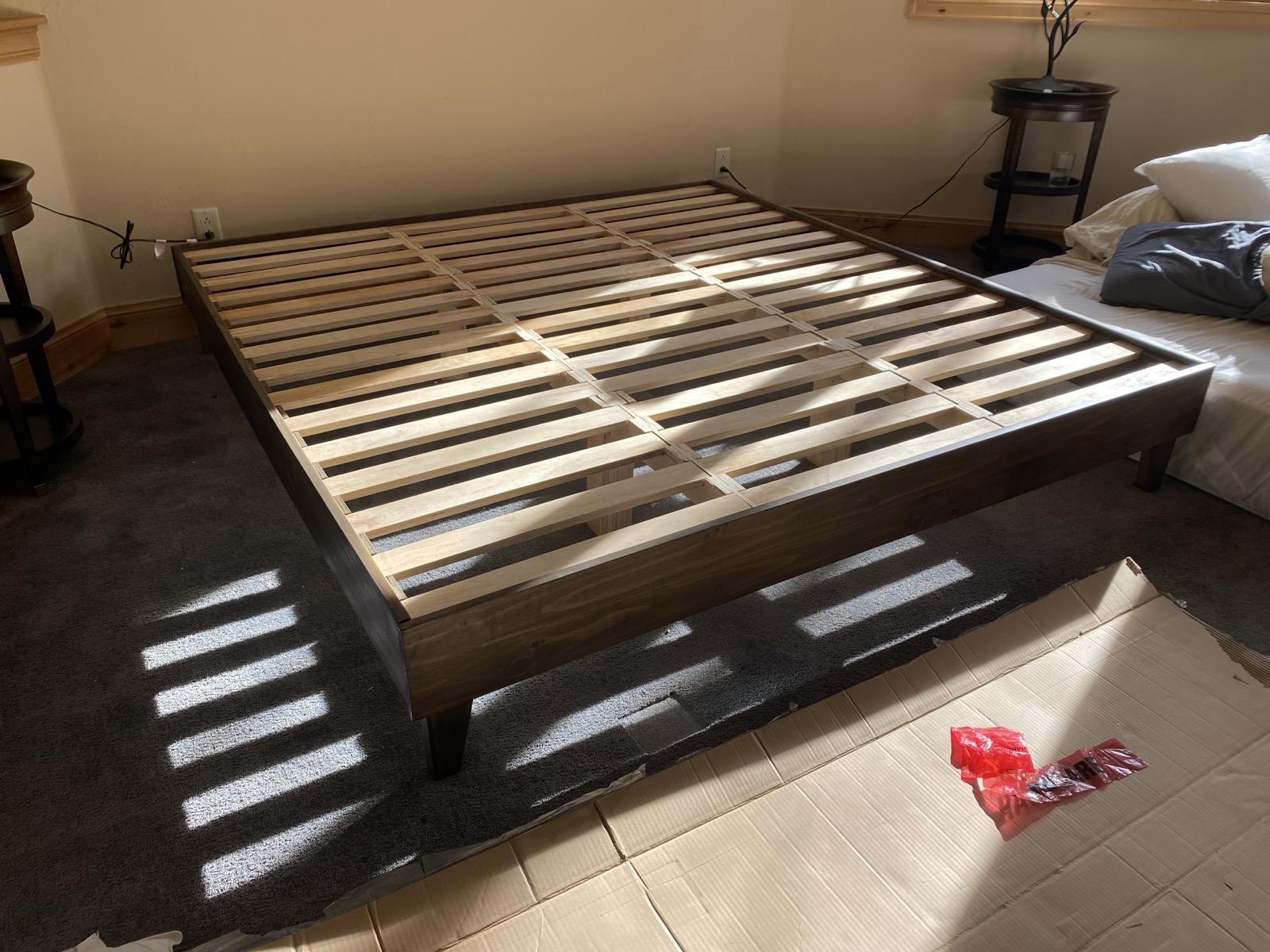
Prioritize solid hardwood with natural finishes or powder-coated metal. These are the cleanest options by a wide margin.
If you already own a bed frame:
- Ventilate — Open bedroom windows when possible, especially in the first year with new furniture. Even cracking a window an inch makes a measurable difference.
- Seal exposed edges — If you can see raw particleboard or MDF (unfinished edges, drill holes, peeled veneer), seal them with shellac. It's the most effective DIY formaldehyde barrier.
- Air out new furniture — Unbox new bed frames in a garage, covered porch, or well-ventilated room for 3-7 days before putting them in the bedroom. Peak emissions happen in the first week.
- Control humidity — Keep bedroom humidity between 30-50%. High humidity dramatically accelerates formaldehyde emissions. A basic hygrometer costs $10.
- Consider testing — If you have persistent unexplained eye irritation, headaches, or respiratory symptoms that improve when you leave the bedroom, a $50-150 formaldehyde test kit can confirm or rule out furniture emissions.
The perfect bed frame doesn't exist for everyone. But understanding what's in your furniture puts you in a position to make choices that match your priorities.
And after breaking down thousands of frames at my recycling facility, I can tell you: what's inside varies far more than most people realize.

Related Guides
- Eco-Friendly & Non-Toxic Bed Frames for a Healthy Bedroom
- Toxins in Your Bedroom: What's Actually Worth Worrying About
- Mold on Your Mattress: What It Is, Why It Happens, and What to Do
- How Bed Frames Are Built (And What Makes Them Last)
- Why Bed Frames Fail
- Fiberglass in Mattresses: What I've Learned Tearing Them Open
- Memory Foam vs. Latex: Which Actually Lasts Longer?
- What's Inside a Mattress (Materials Guide)